

Why Planning Comes Before Purchasing
Most budget furnishing mistakes happen before a single item is purchased. Without a concrete plan, it's easy to buy pieces that don't fit your space, duplicate what you already have, or spend your limited dollars on items that don't serve your daily needs.
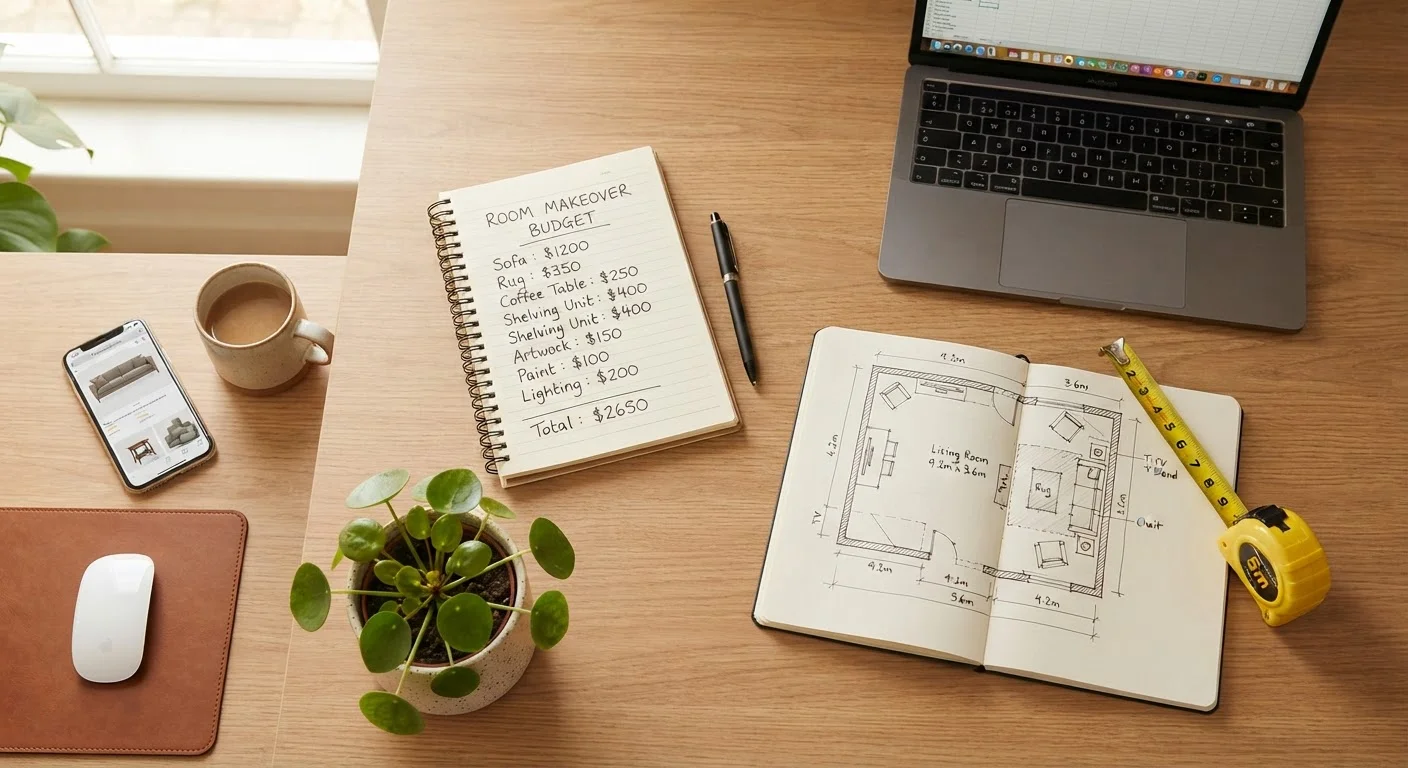
Start with your floor plan. Measure every room and note doorway widths — furniture that can't get through your front door is a genuine and common problem. Sketch a rough layout for each room so you know what sizes will actually work. Scale and proportion matter more than price in a small room, and buying the wrong-sized piece — even a cheap one — wastes money.
Write down what you currently own and what each room genuinely needs to be functional. This inventory step takes less than an hour and can prevent weeks of returns and regret.
Measure Twice, Buy Once
Before shopping, tape out the footprint of larger pieces — like a sofa or bed — on your actual floor using painter's tape. This simple step makes abstract dimensions concrete and prevents purchases that won't physically work in your space. Also measure doorways, hallways, and stairwells if the furniture needs to travel through them.
Setting a Realistic Furniture Budget
A furniture budget isn't just a spending ceiling — it's a sequencing tool. Knowing how much you have to work with tells you which rooms to address first and which purchases to defer.
Build your budget around total available funds, not per-item prices. Then account for costs that don't appear on price tags: delivery charges, assembly fees, furniture pads, and basic tools. These add-ons routinely catch new buyers off guard. This end-to-end guide covers every factor to weigh before spending a dollar on furniture, including line items many shoppers overlook.
If your total is limited, treat furnishing as a multi-month project rather than a single event. Spreading purchases over time prevents financial strain and gives you the flexibility to find better deals. For broader financial context, stretching every dollar and avoiding common money-wasting habits applies just as much to home furnishing as to any other category.
Prioritizing What You Actually Need First
When every dollar is spoken for, the order of purchases matters as much as the purchases themselves. A clear priority framework stops you from spending on secondary items before the essentials are covered.
Essential furniture — pieces that directly affect sleep, eating, and daily function — should come first. A bed or mattress, basic seating, and a surface to eat from are the foundation. Everything else, including storage, decorative pieces, and secondary seating, can follow once your core budget isn't stretched.
Knowing which pieces to buy first — and which can wait — makes furnishing a new place far less overwhelming. Similarly, separating genuine necessities from nice-to-haves is a discipline that protects your budget from day one.
Understanding Materials and Value
At lower price points, construction quality varies enormously — and the difference often isn't visible from a product photo. Understanding basic materials helps you distinguish furniture that will hold up from furniture that just looks like a deal.
Solid wood is generally the most durable option but commands higher prices. Engineered wood — plywood and MDF — offers reasonable durability at lower cost when used in appropriate applications. Particleboard, the least expensive option, is common in flat-pack furniture and can perform adequately if handled carefully, but it's vulnerable to moisture and doesn't hold screws as well over time.
Learn how different furniture materials compare in durability, cost, and longevity so you can make smarter choices at every price point. And once you've bought, simple maintenance habits can dramatically extend the life of budget furniture.
New, Secondhand, or Flat-Pack: Weighing Your Options
Budget shoppers have more sourcing options than ever, and each route involves genuine trade-offs.
Secondhand furniture can deliver substantial savings, particularly on solid-wood pieces that retain structural integrity for decades. The risk is condition: upholstered items especially require close inspection for odors, stains, and pests. Used furniture can save you hundreds — but it comes with its own risks worth understanding before you commit.
Flat-pack furniture is widely available at accessible price points and ships compactly, reducing delivery costs. Its durability depends heavily on correct assembly — most failures trace back to the build process, not the materials. Most flat-pack furniture problems start at assembly.
Multifunctional pieces — storage beds, fold-out tables, ottomans with storage — can replace several single-purpose items and stretch a constrained budget further. Pieces that serve double or triple duty can replace several single-purpose items.
Mistakes That Cost Budget Shoppers the Most
Even with a solid plan, a few common errors consistently push spending past budget.
- Buying without measuring. A sofa that's six inches too wide for your wall doesn't become usable with creative arrangement. Always measure before purchasing.
- Treating price as a proxy for value. The lowest price isn't always the worst deal, but assuming it is often leads to replacing items sooner than expected. Price and value aren't the same thing.
- Ignoring product specs. Weight limits, material disclosures, and dimension tolerances matter. Product pages are packed with details many shoppers overlook.
- Furnishing all at once. Trying to fill a home in a single weekend almost always produces overspending and buyer's remorse. A phased approach gives your budget room to breathe.
Finally, sequencing your home purchases wisely extends to non-furniture items too — understanding the full picture of what a new home requires helps you allocate limited dollars without gaps or redundancies.
Particleboard
A manufactured wood product made from compressed wood chips and adhesive. It's the least expensive common furniture material and is more vulnerable to moisture and screw wear than solid or engineered wood.
Engineered wood
A category of manufactured wood products — including plywood and MDF — made by bonding wood fibers or layers together. Generally more stable than particleboard and less expensive than solid wood.
Flat-pack furniture
Furniture sold disassembled in a box, designed for the buyer to put together at home. It's typically less expensive and easier to ship, but durability depends heavily on correct assembly.
Multifunctional furniture
Furniture designed to serve more than one purpose — such as a storage ottoman or a sofa bed — allowing a single piece to replace two or more single-use items.
Phased furnishing
An approach to furnishing a home over time rather than all at once, buying essential pieces first and adding secondary items as budget allows.
Weight limit
The maximum load a piece of furniture is rated to safely support, as specified by the manufacturer. Exceeding this can damage the piece and create a safety hazard.