
The Core Trade-Off
Every time you consider adding a tool to your home, you're making a quiet decision about how you want to live. Multi-use tools promise to do more with less — one device that handles several jobs, freeing up drawer space and reducing clutter. Single-purpose gadgets take the opposite stance: one job, done well, every time.
Neither approach is inherently smarter. The tension between them comes down to three factors — how often you use a given function, how much space you have, and what performance level you actually need. Getting those three variables right means fewer impulse purchases and more tools you'll genuinely reach for. If you're still working out what your home actually needs, our guide on what makes a household item truly essential is a useful starting point.
Where Multi-Use Tools Have the Edge
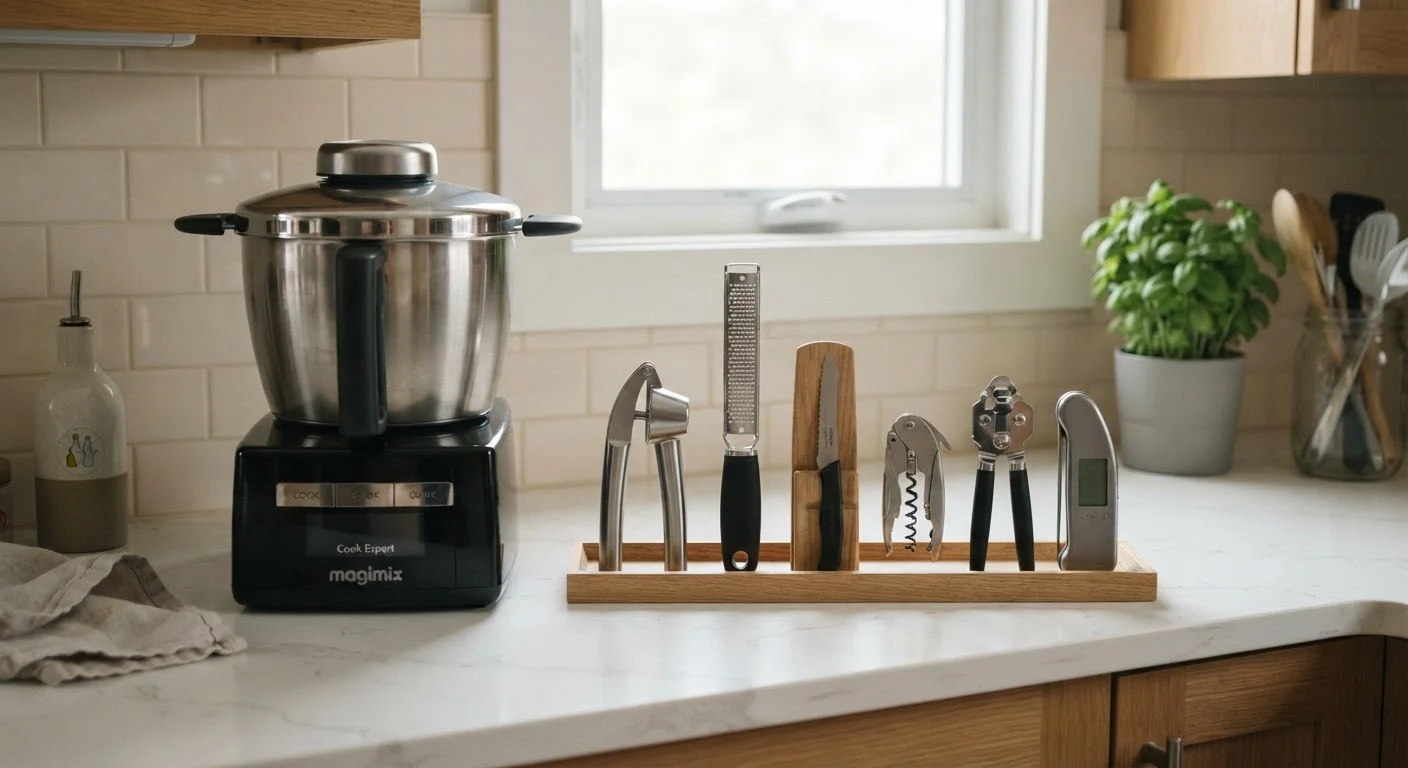
The strongest argument for multi-use tools is consolidation. A single appliance that can blend, chop, and mix occupies one footprint instead of three. For renters, apartment dwellers, or anyone setting up a first home on a limited budget, that matters. You're not paying for three items, and you're not finding storage for three items.
Multi-use tools also suit occasional users well. If you only need a spiralizer or a food grinder a few times a year, a multi-attachment device covers the gap without the cost or clutter of dedicated hardware. Setting up a kitchen without overbuying explores this logic in depth — not every function needs its own machine.
Space efficiency extends beyond the kitchen, too. Multi-head screwdriver sets, combination measuring tools, and convertible furniture all reflect the same principle: one object replacing several. Multifunctional furniture applies exactly this thinking to how rooms themselves are arranged.
| Multi-Use Tools | Single-Purpose Gadgets | |
|---|---|---|
| Space required | Low — one footprint for many tasks | Higher — one device per task |
| Upfront cost | Often lower overall | Can add up across multiple items |
| Performance per task | Moderate — trade-offs across functions | High — optimized for one job |
| Ease of use | More complex, more settings | Simpler, purpose-built controls |
| Best suited for | Occasional users, small spaces | Frequent users, performance-driven needs |
| Durability | Varies; shared components may wear faster | Generally more robust per function |
When Single-Purpose Tools Earn Their Keep
A dedicated tool built for one task typically outperforms a multi-use alternative at that task. A stand mixer beats a blender attachment for bread dough. A dedicated handheld steamer outperforms an iron's steam function when you're steaming garments daily. Performance gaps tend to widen with frequency — the more you rely on a specific function, the more those small shortfalls add up.
Single-purpose tools also tend to be simpler to operate and maintain. Fewer moving parts, clearer controls, and easier cleaning. For tools you use every day — a kettle, a coffee maker, a good knife — simplicity and reliability often justify the dedicated approach even if storage is tight.
Durability is another consideration. Multi-use devices sometimes compromise build quality across all their functions to keep cost and size manageable. A single-purpose tool at the same price point can afford to put all its engineering into one job.
A Framework for Deciding
Before buying either type, run through a short set of questions. First, how often will you use this function — daily, weekly, or a few times a year? Daily use almost always favors a dedicated tool. Occasional use favors multi-use. Second, do you already own something that covers this need partially? If so, a multi-use upgrade may consolidate without adding clutter. Third, does performance quality in this specific task directly affect your experience? If yes, a single-purpose tool is likely worth the footprint.
The broader principle is that owning fewer, better-chosen items often beats accumulating both types without a plan. Volume is not the same as utility. A drawer full of rarely-used gadgets — whether multi-use or single-purpose — costs money, takes space, and adds friction to daily life.
For a more complete view of how household needs evolve over time and how to build a toolkit that grows sensibly, see The Full Picture on Home Essentials.