
The Overbuying Trap in Kitchen Setup
Setting up a kitchen for the first time — or starting fresh after a move — puts you in the crosshairs of some very persuasive marketing. Complete knife sets. Twelve-piece cookware bundles. Appliances that promise to do everything. The result is often a kitchen stuffed with tools you rarely touch and a credit card balance that didn't need to be that high.
The pattern mirrors what happens across the rest of the home. As explored in our guide on stocking a home on a tight budget, sequencing purchases thoughtfully almost always beats buying everything at once. The kitchen is no exception. Overbuying isn't just a spending problem — it creates clutter that makes cooking harder, not easier.
The fix isn't complicated: start with less, cook with it, and let real use tell you what's actually missing.
The Core Tools That Actually Earn Their Space
Every functional kitchen is built around the same short list of hand tools. These are the items you'll reach for daily:
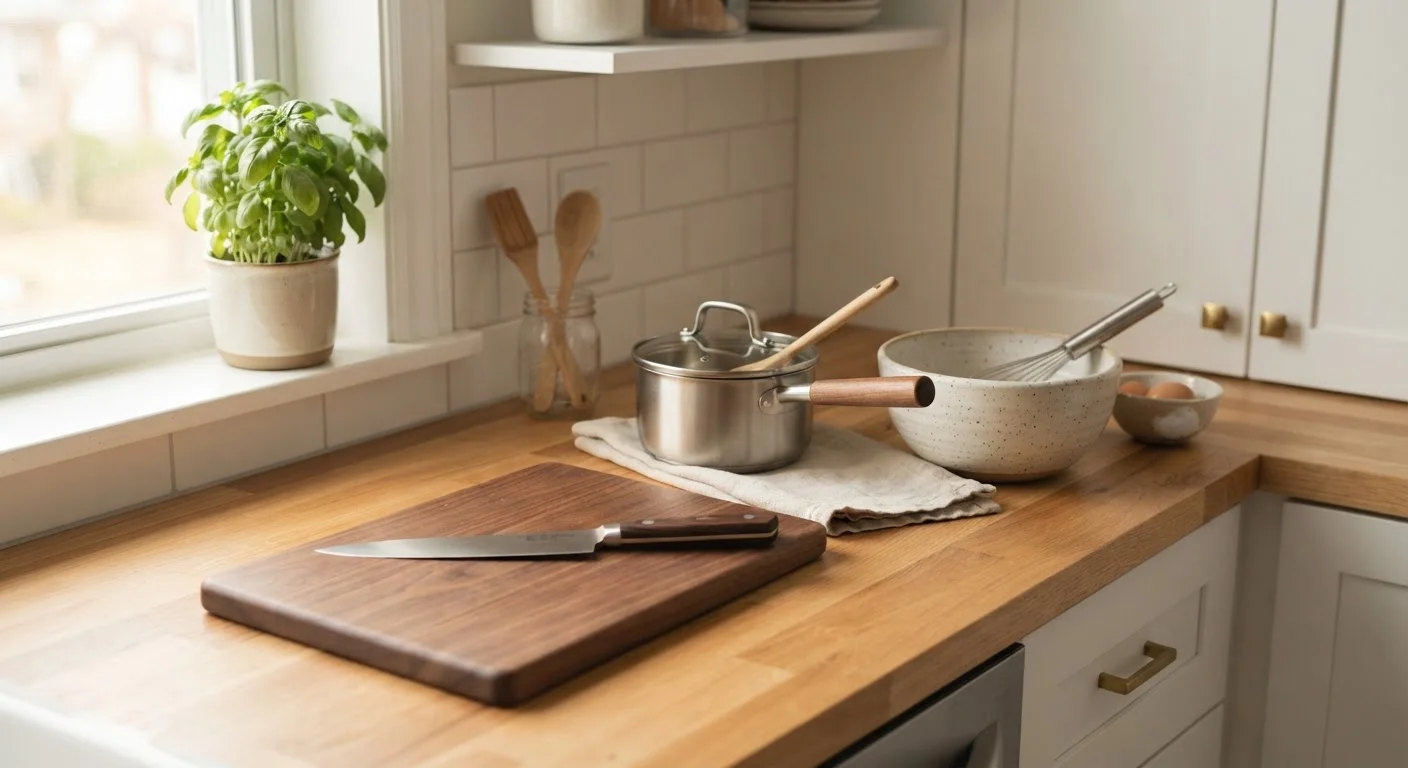
- Chef's knife (8-inch) — handles the overwhelming majority of prep work, from dicing vegetables to breaking down a whole chicken.
- Cutting board — one large board in wood or plastic. Bigger is almost always better.
- Wooden spoon and silicone spatula — between them, they cover stirring, folding, and flipping across every cooking surface.
- Measuring cups and spoons — critical for baking, useful for everything else.
- Box grater — replaces several single-purpose tools: cheese grater, zester, shredder.
- Colander — for draining pasta, washing produce, and rinsing beans.
- Mixing bowls (nested set) — a nested set of two or three covers prep, mixing, and serving.
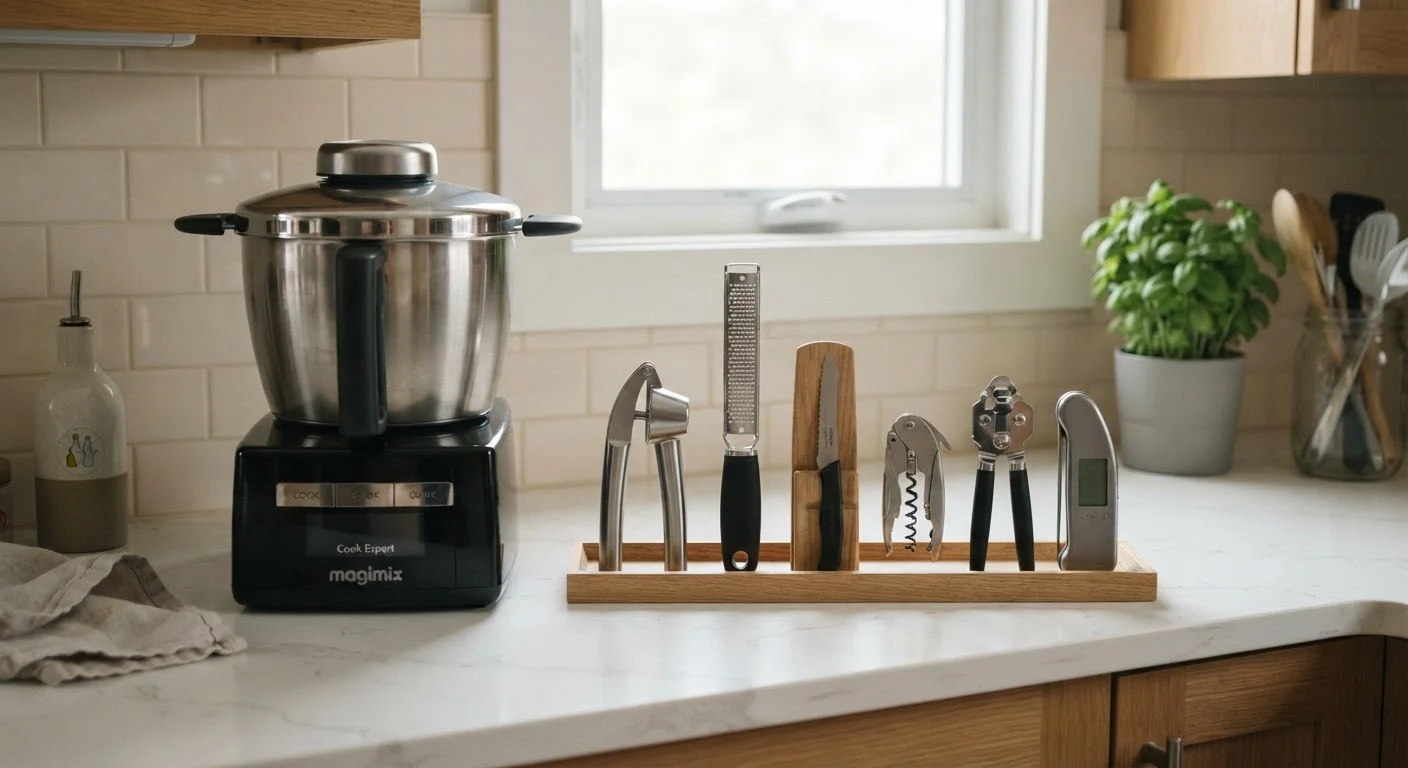
Notice what's not on this list: a garlic press, an avocado slicer, a strawberry huller, or any tool that does exactly one thing. For a deeper look at the trade-offs between multi-use and single-purpose items, see our piece on multi-use household tools vs. single-purpose gadgets.
The One-Question Test for Any Kitchen Tool
Before adding any item to your cart, ask: 'Can I do this with something I already own?' A chef's knife handles most tasks a specialty tool claims to make easier. If the honest answer is yes, skip it. Revisit in three months if you still feel the gap.
Cookware: Start Small, Cook More
Cookware is where most kitchen budgets balloon fastest, partly because sets are heavily marketed and partly because more pieces feel like better value. They rarely are.
A starter cookware lineup needs only three or four pieces:
- 10- or 12-inch skillet — your most-used pan. Handles sautéing, searing, frying eggs, and pan sauces.
- 3- to 4-quart saucepan with lid — for soups, grains, sauces, and boiling smaller quantities.
- Large stockpot (6–8 quart) — pasta, big batches of soup, blanching vegetables.
- Sheet pan (half-sheet size) — roasting vegetables, baking, sheet-pan dinners. Indispensable and inexpensive.
A Dutch oven can be added later — it's versatile enough to replace both the saucepan and stockpot in many kitchens, but it's a higher upfront cost. Wait until you know your cooking habits before committing.
On material: durability matters more than prestige. A mid-weight pan that won't warp will serve you far longer than a thin, cheap set — even if the set has more pieces.
Appliances: Where Restraint Pays Off
Countertop appliances are the biggest source of kitchen buyer's remorse. They're expensive, they take up space, and many get used a handful of times before being pushed to the back of a cabinet.
Apply a simple filter: Would I realistically use this at least once a week? If not, it doesn't belong on your initial list.
The appliances that genuinely pass that test for most households:
- Microwave — reheating, defrosting, and faster cooking. Legitimately used daily by most households.
- Electric kettle — faster than a stovetop for hot water; useful for tea, coffee, oatmeal, and blanching prep.
- Toaster or toaster oven — a toaster oven earns more versatility per dollar by also handling small bakes and reheating without heating a full oven.
A coffee maker crosses the threshold for daily coffee drinkers. A stand mixer or food processor rarely does for beginners — tasks they handle can usually be done by hand or with a hand mixer at a fraction of the cost and storage footprint.
This same logic — fewer, genuinely useful items over a collection of single-purpose ones — applies throughout the home. Our article on owning fewer things and running a better home explores that principle in full.
Building Out Over Time
A kitchen is not a one-time purchase — it's something you grow into. After a few months of cooking with a lean setup, you'll know exactly what you actually need because you'll have reached for it and found it missing. That's the right time to add.
Common second-wave additions include a cast-iron skillet (once you're comfortable maintaining it), a hand blender for soups and sauces, a baking dish for casseroles and roasts, and a salad spinner if you eat a lot of greens. These are real tools that earn their keep — but only once you've confirmed you'll use them.
If you're furnishing an entirely new home at the same time, the same discipline applies to every room. Our guide on furnishing a home on a tight budget walks through that broader planning process.
The kitchen that works best isn't the one with the most in it. It's the one where everything has a purpose and everything gets used.