

Why a Monthly Budget Matters
A budget is a written plan that tells your money where to go before the month begins. Without one, spending decisions happen by default — and it's easy to arrive at the end of the month wondering where the paycheck went.
Research by the Consumer Financial Protection Bureau and others consistently finds that households with a written spending plan are better positioned to handle unexpected expenses and build savings over time. A budget doesn't have to be complicated to be effective. The goal of your first one is simply to give you an accurate picture of what's coming in and what's going out.
This guide walks through the process from scratch, without assuming any financial background. If you're new to intentional money management, our introduction to smart spending covers the broader mindset behind spending wisely before you dive into the mechanics here.
Take-Home Pay
The amount of your paycheck after all taxes and payroll deductions have been removed. This is the actual money available to spend, save, or invest.
Fixed Expense
A recurring cost that stays the same amount each month, such as rent, a car payment, or a monthly loan installment.
Variable Expense
A cost that changes in amount from month to month, like groceries, gas, or utility bills. These are harder to predict but often easier to adjust.
Emergency Fund
Money set aside specifically to cover unexpected costs — a car repair, medical bill, or job loss — without disrupting the rest of your budget.
50/30/20 Rule
A popular budgeting guideline that suggests directing 50% of take-home pay to needs, 30% to wants, and 20% to savings and debt repayment above minimums.
Irregular Expense
A cost that doesn't occur every month but is predictable — like annual insurance premiums or vehicle registration fees. These should be saved for monthly to avoid surprises.
Step 1: Add Up Your Take-Home Income
Your budget must be built on take-home pay — the amount that actually lands in your bank account after taxes, Social Security, Medicare, and any other payroll deductions. Using your gross salary (the number before deductions) will make your budget look healthier than it really is.
If you have a single salaried job with a consistent paycheck, this step is straightforward. If your income varies — from hourly work, freelance contracts, tips, or multiple part-time jobs — use a conservative estimate: an average of your three lowest recent months is a practical starting point. Include all reliable income sources: wages, side work, child support received, regular government benefits, or any other recurring inflow.
Write that total at the top of a blank page or spreadsheet. Everything else in your budget flows from this number.
Step 2: List and Categorize Your Expenses
Pull up your last two to three bank and credit card statements and list every expense you can find. Then sort them into three broad buckets:
- Needs: Rent or mortgage, utilities, groceries, transportation to work, minimum debt payments, and basic insurance.
- Wants: Dining out, streaming services, gym memberships, hobbies, and anything you could live without in a pinch.
- Savings and debt repayment: Emergency fund contributions, retirement account deposits, and any extra payments above the minimum on debts.
One category most first-time budgeters overlook is irregular but predictable expenses — car registration, annual subscriptions, back-to-school costs, and similar items. Take the annual total of each and divide by 12 to get a monthly figure to set aside. Our article on the budget category most households skip covers this in detail.
For a reliable way to track these figures going forward, see our guide on tracking every dollar each month.
Step 3: Balance the Numbers
Subtract your total monthly expenses from your take-home income. There are three possible outcomes:
- Income exceeds expenses: You have room to direct surplus dollars toward savings, an emergency fund, or extra debt payments — prioritize those intentionally rather than letting the surplus disappear.
- Expenses equal income: Everything is accounted for, but there's no cushion. Look closely at your wants category for small cuts that create a safety margin.
- Expenses exceed income: Your budget is showing a shortfall. Review each expense line by line: Are there subscriptions you've forgotten about? Fixed costs that could be reduced by calling a provider? Small cuts in multiple categories often add up faster than one large change.
Don't be discouraged if the first pass reveals a gap. Seeing the gap honestly is the entire point — it's information, not failure.
Step 4: Choose a Simple Starting Framework
Once you have your income and expense totals, applying a structure helps you decide whether your current allocation makes sense. One of the most accessible frameworks is the 50/30/20 rule: roughly 50% of take-home pay toward needs, 30% toward wants, and 20% toward savings and debt repayment beyond minimums.
These percentages are guidelines, not rigid rules. If you live in a high-cost city, your needs may naturally run higher. If you're carrying significant debt, you might shift more toward repayment and less toward wants. The framework gives you a benchmark to measure against, not a prescription to follow exactly.
There are other approaches worth knowing about. Our comparison of four popular budgeting frameworks explains how the zero-based, pay-yourself-first, and envelope methods differ — useful reading once you've worked through one full month with a basic plan.
Start With One Month's Real Data
Before locking in any budget percentages, spend one month simply tracking where your money actually goes without changing anything. This gives you an honest baseline that's far more useful than an estimate. Many people are surprised by how their real spending compares to what they assumed it was.
Making Your Budget Stick
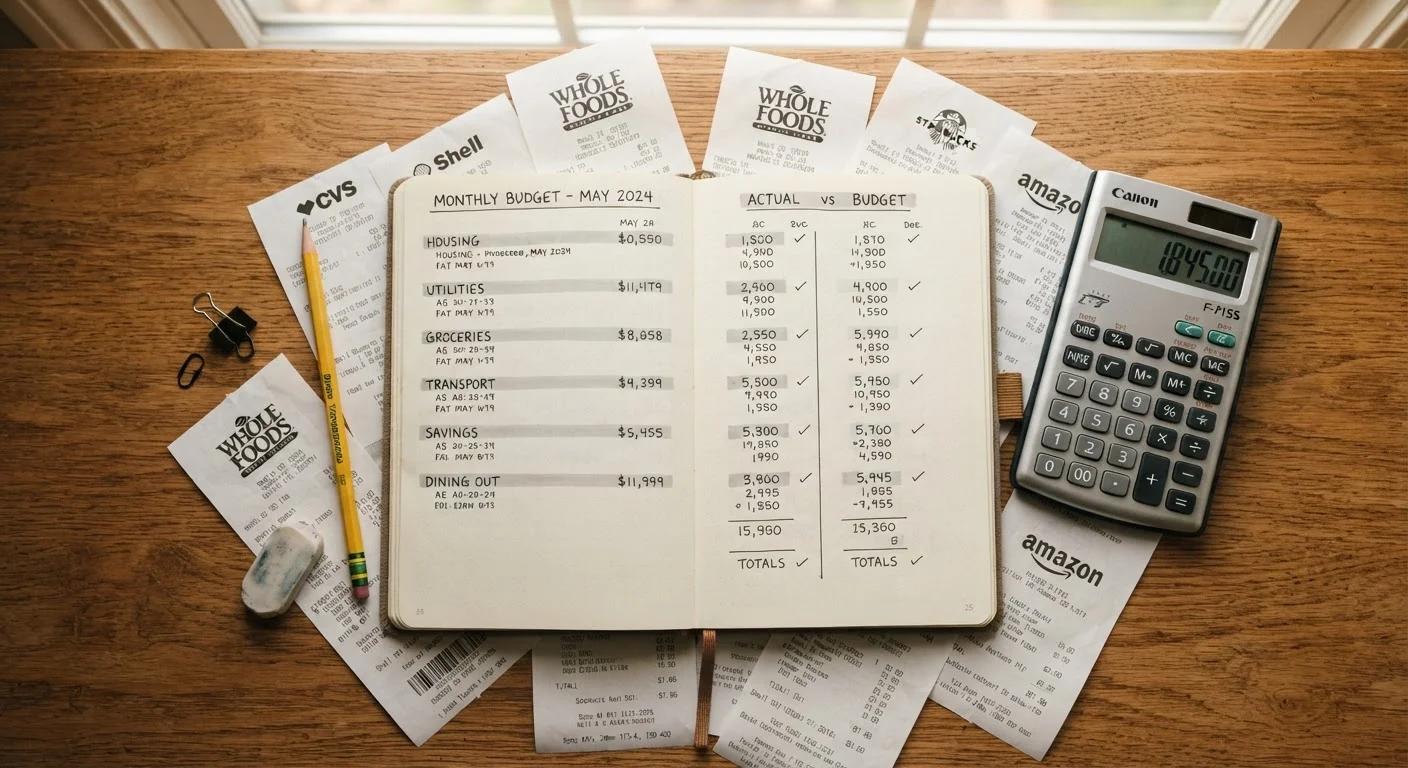
A budget is a living document, not a one-time exercise. Set a recurring monthly check-in — even 20 minutes at the end of each month — to compare what you planned with what you actually spent. This habit is what turns a budget from a piece of paper into a real financial tool.
Expect your first few months to require adjustments. Expense categories you underestimated will show up; spending habits you hadn't noticed will become visible. That's normal. For households managing shared finances, clear communication about spending decisions is equally important — our guide on budgeting as a family or couple addresses those dynamics directly.
For deeper guidance on the habits that keep a budget working long-term, see habits that keep a budget working month after month.
This article is for general informational and educational purposes only and does not constitute personalized financial advice. Consider consulting a qualified financial professional for guidance specific to your situation.