
How Each Technology Actually Works
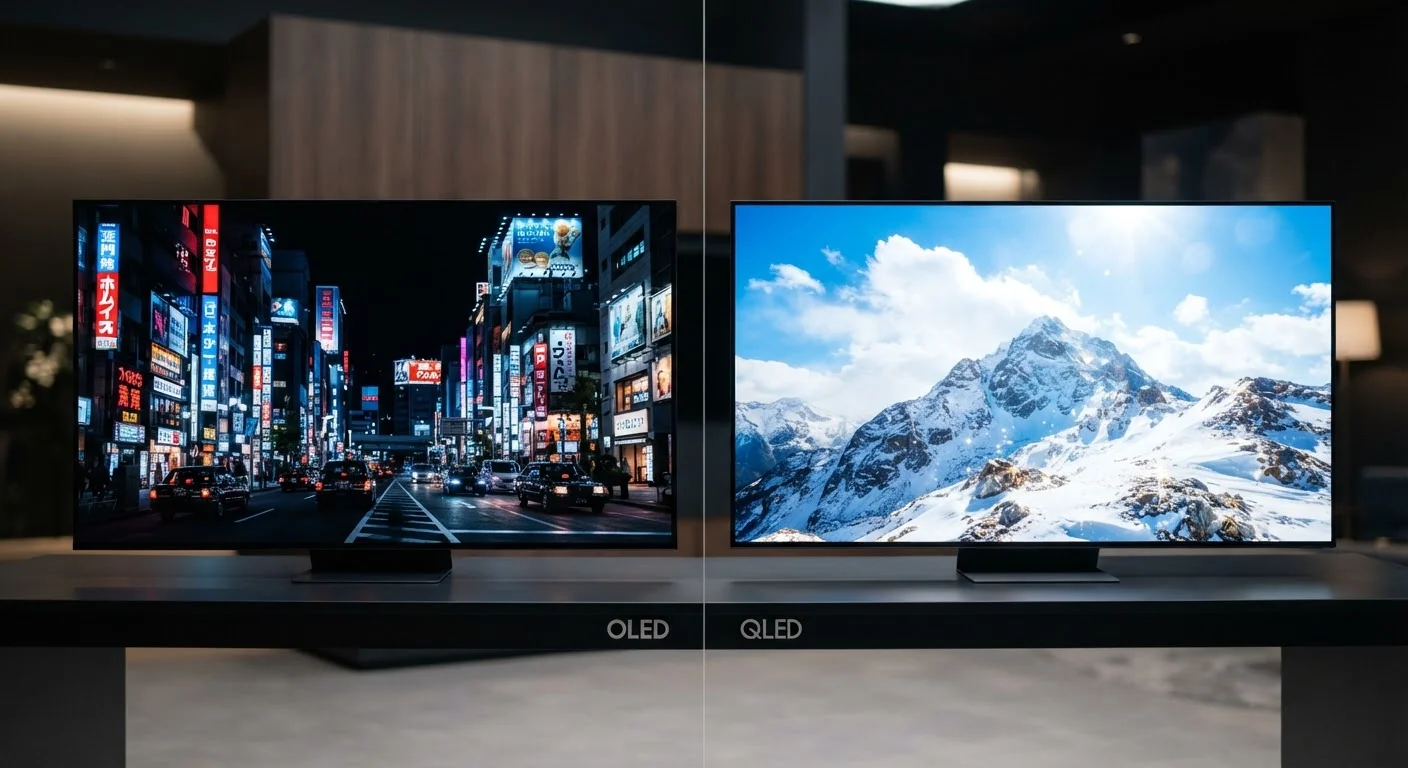
Understanding the real difference between OLED and QLED starts with how each panel produces light — because that single engineering choice cascades into almost every performance tradeoff you'll read about.
OLED stands for Organic Light-Emitting Diode. Each individual pixel in an OLED panel contains an organic compound that emits light on its own when electricity passes through it. There is no separate backlight. When a scene calls for black, those pixels simply switch off completely. This is why OLED is described as self-lit — and it's the reason OLED panels can achieve what engineers call a theoretically infinite contrast ratio.
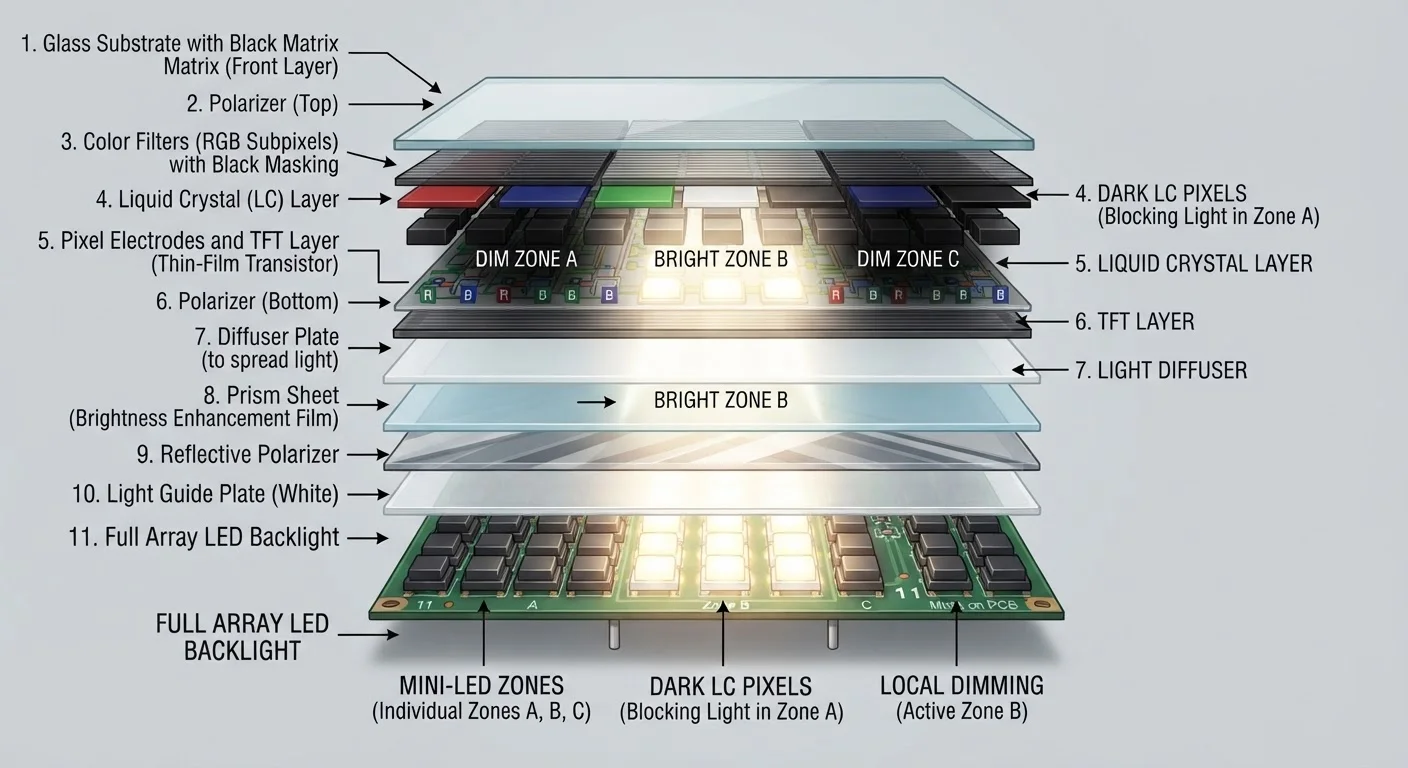
QLED is a marketing term used to describe LED-backlit LCD panels that include a quantum dot filter layer. Quantum dots are nanoscale semiconductor crystals that convert the backlight's blue LED light into very pure red and green wavelengths, which produces a wider, more saturated color gamut than standard LED-LCD panels. The LCD layer in front still controls what the viewer sees, but that underlying backlight is always on to some degree. For a deeper look at how backlight design shapes LCD picture quality, see our explainer on full-array local dimming vs. edge-lit panels.
| Criterion | OLED | QLED |
|---|---|---|
| Light source | Self-lit organic pixels | LED backlight + quantum dot layer |
| Black level | True black (pixel off) | Near-black (backlight glow) |
| Peak brightness | Lower ceiling | Significantly higher |
| Contrast ratio | Effectively infinite | High, but finite |
| Burn-in risk | Present with static images | Not a known risk |
| Viewing angle | Wide, consistent color | Narrows off-axis |
| Color volume | Excellent | Excellent |
| Best room lighting | Dark or dim rooms | Bright or mixed-light rooms |
If you're still building your display vocabulary, our glossary of screen resolution terms covers many of the labels you'll encounter alongside OLED and QLED while shopping.
Where Each Technology Wins — and Where It Falls Short
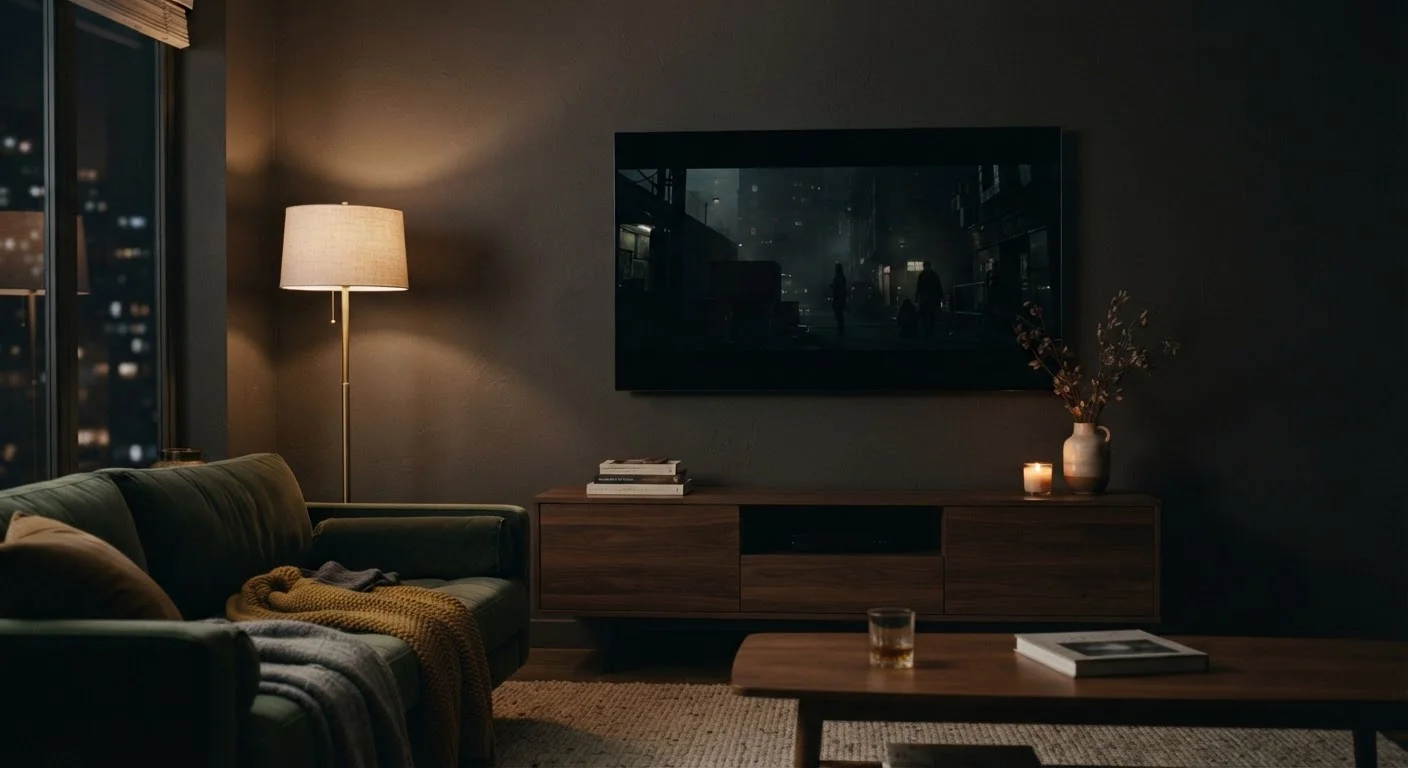
Contrast and black levels go decisively to OLED. Because pixels turn off individually, dark scenes show true black rather than the slight gray glow that even a high-quality LCD backlight produces. This matters most in dim or dark rooms where your eyes are sensitive to that glow.
Peak brightness is QLED's defining advantage. A backlit panel can push light output far higher than current OLED technology, which is constrained by the organic compounds' heat tolerance. In a sun-drenched living room, a QLED display will maintain visible picture detail that an OLED panel may struggle to match. Our article on why a bright showroom TV can disappoint at home explains why ambient light changes the equation so dramatically once a set leaves the store.
Burn-in risk is a real, if manageable, concern with OLED. When the same static image occupies a fixed screen position for extended periods — think a news ticker, a channel logo, or a game's heads-up display — the organic materials in those pixels can degrade faster than their neighbors, leaving a faint permanent ghost. QLED panels do not share this vulnerability. Modern OLED sets include pixel-shift features and screen savers to reduce the risk, but it cannot be entirely eliminated.
Viewing angles favor OLED. LCD panels, including QLED, lose color accuracy and brightness as you move off-center from the screen. OLED's self-emissive pixels maintain consistent color from wider angles, which matters in a room where seating isn't all directly in front of the screen.
For readers considering newer backlight alternatives, our comparison of Mini-LED vs. MicroLED puts those technologies in context alongside OLED and QLED.
0.0005 nits
Typical OLED minimum black level
Display measurement labs consistently record OLED black levels near zero, a figure that LED-backlit panels cannot approach regardless of local dimming quality.
2,000+ nits
Achievable QLED peak brightness
High-end QLED panels have demonstrated peak brightness figures exceeding 2,000 nits in independent testing, compared to around 800–1,000 nits for most OLED sets.
120 Hz
Refresh rate available on both technologies
Both OLED and QLED panels are widely available with 120 Hz refresh rates, meaning neither technology has a meaningful native advantage for motion smoothness.