
Why the Backlight Is Everything
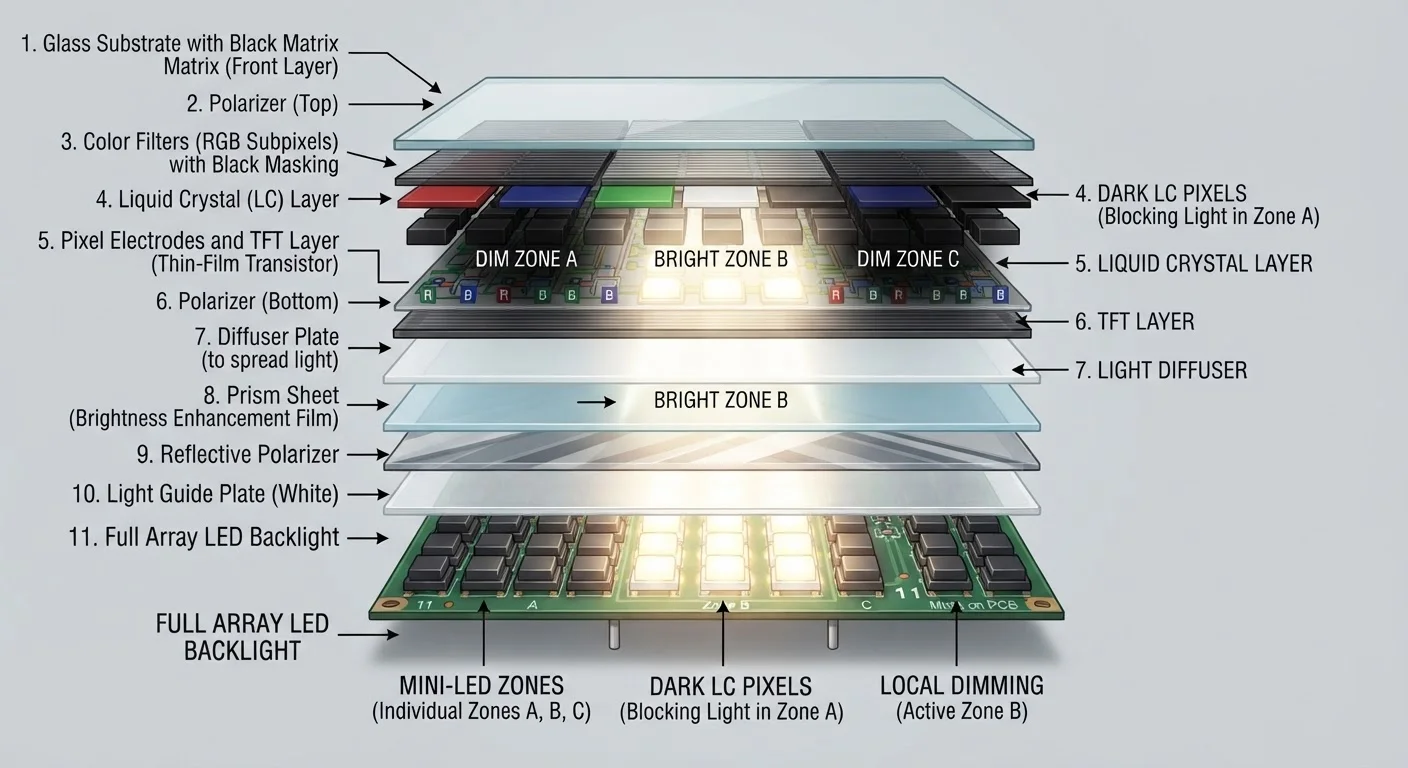
All three display types — LED, QLED, and OLED — ultimately create the image you see, but they do it in very different ways. To understand why, it helps to know that most TVs sold today are still fundamentally LCD panels: liquid-crystal layers that block or allow light through. The real question is where that light comes from and how precisely it can be controlled.
Standard LED TVs shine an array of light-emitting diodes behind the LCD layer. Those LEDs illuminate the entire screen, and the crystals modulate how much light passes through each area. It works well, but the backlight can't easily turn off in one small corner while staying bright in another. This limits how deep blacks can appear — a lit background always bleeds through slightly.
For a deeper look at how backlight design shapes real-world picture quality, see our guide to full-array local dimming vs. edge-lit panels.
What QLED Actually Adds to the LED Formula
QLED — which stands for Quantum Light-Emitting Diode — is still an LCD TV at its core. What it adds is a thin quantum dot film placed in front of the LED backlight. Quantum dots are nanoscale semiconductor particles that absorb blue LED light and re-emit it as precisely tuned red or green light. The result is a wider, more accurate color range and a brighter peak output than a standard LED TV can achieve.
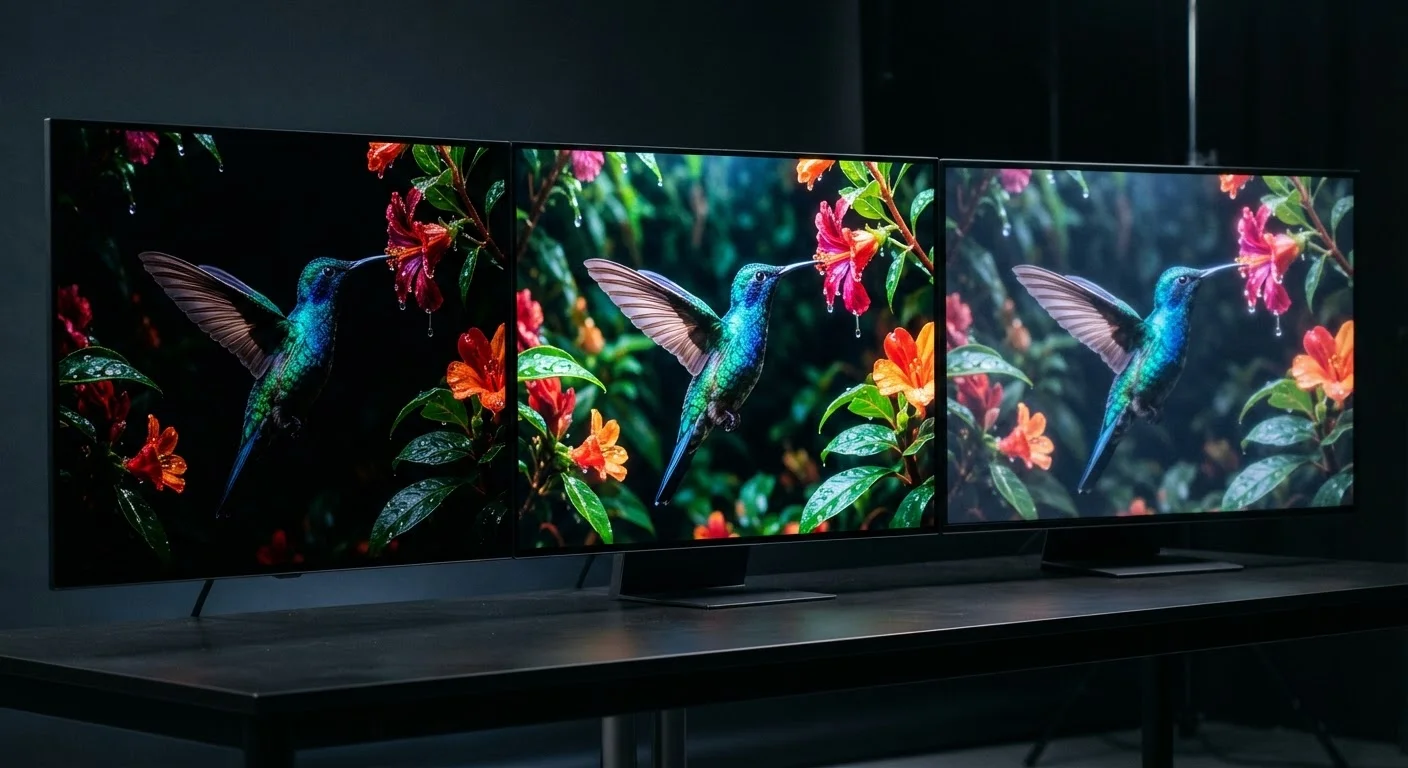
In practice, QLED panels can get significantly brighter — an advantage in sunlit rooms where a dimmer screen would wash out. Their color volume (the ability to display vivid colors even at high brightness) is also a genuine improvement. However, because a QLED is still backlighting an LCD panel, it shares the same fundamental contrast limitation: blacks can look slightly gray in dark scenes unless the TV uses advanced local dimming zones.
| LED | QLED | OLED | |
|---|---|---|---|
| Light source | Backlight behind LCD | Quantum dot-enhanced backlight | Self-lit organic pixels |
| Black level | Limited — backlight bleeds | Improved with local dimming | True black — pixels off |
| Peak brightness | Moderate | High | Moderate to high |
| Color accuracy | Good | Very good | Excellent |
| Burn-in risk | None | None | Low but possible |
| Typical price tier | Entry to mid-range | Mid to premium | Premium |
| Best environment | Bright or mixed rooms | Bright or mixed rooms | Dark or dim rooms |
QLED TVs tend to occupy a middle tier in pricing — more than entry-level LED sets but generally less than OLED. They pair well with HDR content, which relies heavily on peak brightness to show specular highlights.
How OLED Works Differently at the Pixel Level
OLED — Organic Light-Emitting Diode — represents a fundamentally different architecture. There is no backlight at all. Each individual pixel contains organic compounds that produce their own light when electricity passes through them. This means every pixel can be switched completely off, producing a true black rather than a dimmed dark gray.
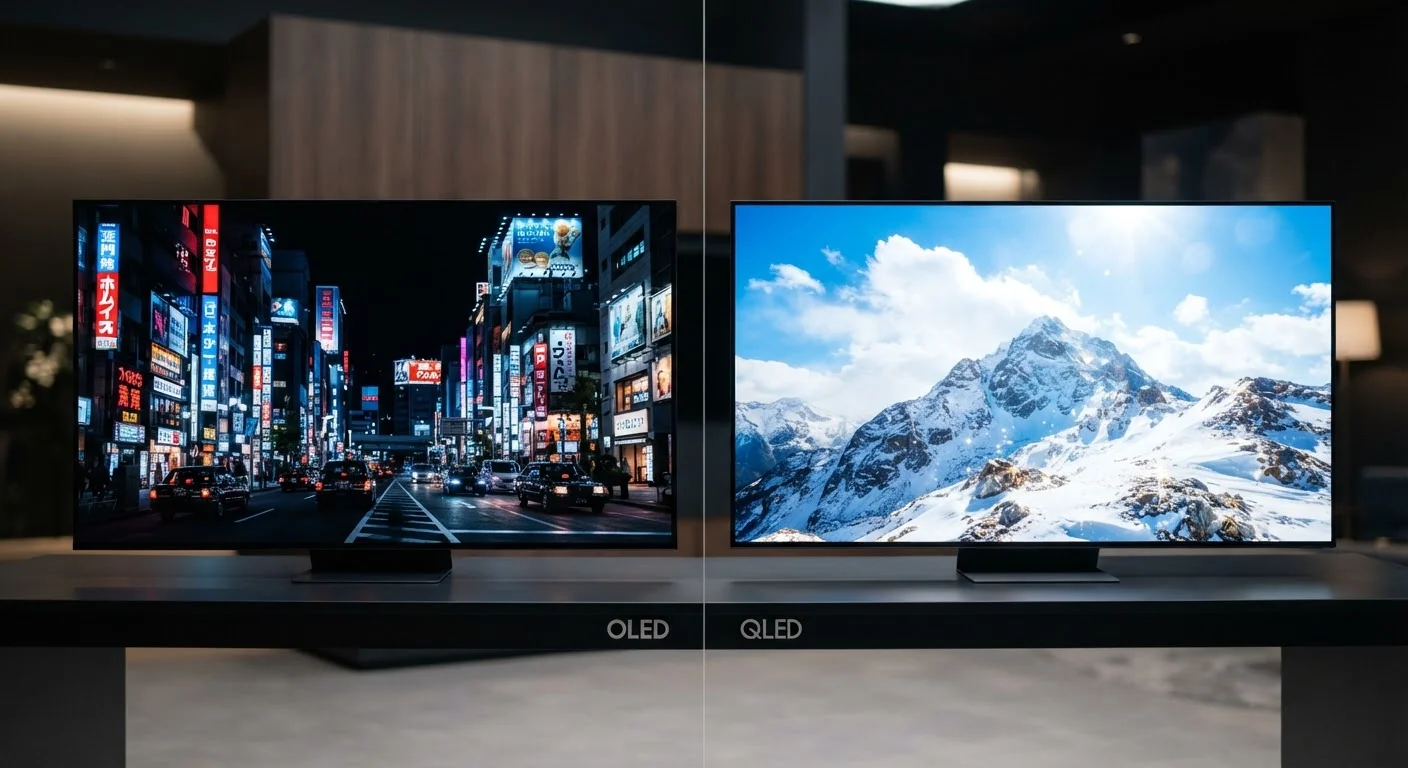
The practical payoff is exceptional contrast. In a dark scene, some pixels display pure black while others glow at full brightness — simultaneously, with no light bleeding between them. This characteristic makes OLED particularly compelling for movies and scripted dramas with cinematic lighting.
Two trade-offs are worth knowing. First, OLED panels typically cannot reach the same peak brightness levels as top-tier QLED sets, which can matter in very bright rooms. Second, static high-contrast images held on screen for extended periods — like a channel logo or a video game HUD — can potentially cause image retention or burn-in over time. Manufacturers have added protective technologies to reduce this risk, but it remains a consideration for viewers who leave a static image on screen for many hours regularly.
For a direct head-to-head between these two premium technologies, our OLED vs. QLED comparison goes deeper on each trade-off.
Matching the Technology to Your Room and Habits
No display technology is universally superior — context shapes which performs best for you.
- Bright rooms with large windows or overhead lighting tend to favor QLED or a bright LED set. Higher peak brightness fights glare, while OLED's more modest brightness ceiling can look subdued under strong ambient light.
- Dark or controlled-light rooms play to OLED's strengths. The perfect blacks and infinite contrast ratio make dark scenes look strikingly realistic.
- Mixed-use viewing — daytime news, sports, evening movies — is where LED and QLED TVs typically offer the most versatile performance at a lower cost.
- Gaming has historically favored OLED for its fast pixel response times, though the burn-in consideration applies if you play games with persistent on-screen overlays for very long sessions.
It's also worth noting that the showroom environment can be misleading. See our explainer on why store TVs can disappoint at home for what to account for before purchasing.
Beyond the panel itself, features like refresh rate and the smart TV platform also shape your daily experience, regardless of which display technology you choose.