
Why Subscriptions Slip Through the Cracks
Subscription billing is designed for convenience — yours and the company's. When a $9.99 or $14.99 charge hits your account automatically each month, it rarely triggers the same mental alarm as a one-time purchase. Over time, these small recurring costs pile up quietly. You might still be paying for a streaming service you switched away from, a fitness app you used twice, or a software trial you forgot to cancel.
This isn't a willpower problem. It's a visibility problem. Most people can't name every active subscription they have without looking it up. A structured audit fixes that by making all your recurring charges visible in one place, so you can make deliberate choices about each one.
For a broader look at where your money is actually going, see our full spending audit guide — it pairs well with the steps below.
What you will need
How to Audit Your Subscriptions
Follow these steps in order. The process takes under an hour for most households, and the payoff is a clear picture of every recurring charge you're carrying.
Pull every bank and credit card statement from the past 90 days
Log into each financial account you use and download or review statements covering the last three months. Look specifically for recurring charges — identical or near-identical amounts hitting on a regular schedule. Don't limit yourself to monthly charges; some subscriptions bill quarterly or annually and are easy to miss on a single statement.
Search your email for billing receipts
Search your inbox for terms like "receipt," "invoice," "renewal," and "your subscription." Many services send email confirmations every billing cycle. This step catches subscriptions charged to cards you may have forgotten about, or services that bill under a parent company name you don't recognize on your statement.
List every recurring charge in one place
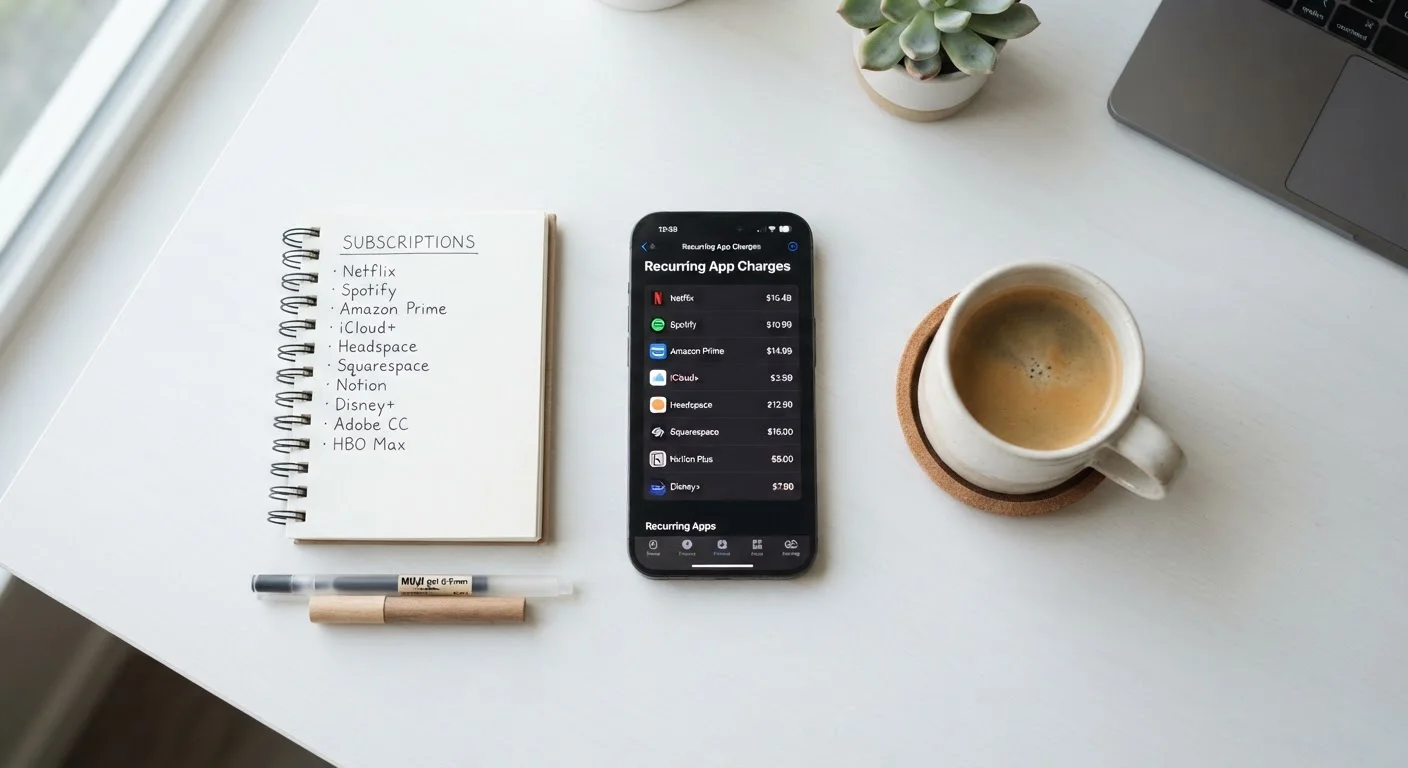
Create a simple table — on paper or in a spreadsheet — with four columns: service name, monthly cost (convert annual charges to a monthly equivalent by dividing by 12), last time you used it, and a keep/cancel decision. Record every charge you found, even ones you're confident you want to keep.
Evaluate each subscription honestly
For each line item, ask yourself two questions: Have I used this in the past 30 days? Would I notice if it disappeared tomorrow? If the answer to both is no, that's a strong signal to cancel. For services you use occasionally, consider whether a pay-per-use option or a pause feature might be more cost-effective than a continuous subscription.
Cancel or downgrade what you don't need
Work through your cancel list one by one. Most services allow cancellation through account settings — look for "billing," "plan," or "membership" in the account menu. Some companies require you to call or chat with a representative; have your account information ready. Note that canceling usually takes effect at the end of the current billing period, so you won't be charged again after that date.
Once you've completed your audit, build subscription review into your regular financial routine. Many households find it useful to add subscriptions as a named line item in their monthly budget — our guide on budget categories most households skip explains why predictable recurring costs deserve their own dedicated space.
Staying on Top of Subscriptions Going Forward
An audit is only useful if you don't land back in the same spot six months later. A few habits make all the difference.
Set a calendar reminder to review your subscriptions every three months. When you sign up for a new service — especially a free trial — mark the billing start date in your calendar immediately and decide in advance whether you intend to pay for it. If you're not sure, cancel before the trial ends and re-subscribe if you miss it.
Consider routing all subscription charges to a single credit or debit card. When every recurring bill lands in one place, your monthly statement becomes a ready-made subscription log. Pair this with practical spending tracking methods to keep the full picture accurate.
Finally, if you want your budget to work on autopilot for the expenses you do want to keep, explore automating your finances so that savings and debt payments stay on schedule even when life gets busy.
Make One Card Your Subscription Card
Routing all recurring charges to a single payment method is one of the simplest ways to keep subscriptions visible. When your review time comes around, you only need to look at one statement. It also makes it easier to spot unauthorized charges early.
This article is for general informational purposes only and does not constitute personalized financial advice. Consult a qualified financial professional for guidance specific to your situation.