

How Interest Charges Actually Build Up
Many people think of a credit card balance as a fixed number that grows only when they make new purchases. In reality, interest is working on that balance every single day.
Here is a simplified look at the math. If your card carries a 22% APR — close to the national average for accounts that carry balances — the daily periodic rate is roughly 0.06%. On a $3,000 balance, that amounts to about $1.80 in interest on day one. That charge is added to your balance, so day two's interest is calculated on $3,001.80, and so on. It sounds small, but across a full year of minimum payments, the compounding effect can add hundreds of dollars to what you repay.
For a deeper look at the terminology behind these calculations, see key terms every debt and savings conversation relies on — it covers APR, principal, and compounding in plain language.
~22%
Average APR on cards carrying a balance
According to Federal Reserve data, the average interest rate on credit card accounts assessed interest has hovered in this range in recent years.
Millions
U.S. adults carrying credit card balances month to month
Federal Reserve surveys consistently find that a substantial share of American cardholders do not pay their balance in full each month, making compounding interest a widespread issue.
2x+
Potential total repayment vs. original balance
On a high-APR card with minimum-only payments, total interest paid over the repayment period can exceed the original balance, depending on the rate and payment amount.
The Real Price of the Minimum Payment Trap
Card issuers set minimum payments low — often around 1–2% of the outstanding balance or a small flat dollar amount, whichever is greater. From a cash-flow perspective this feels manageable. From a total-cost perspective, it is expensive.
Consider a $3,000 balance at 22% APR with a minimum payment of roughly $60 per month. At that pace, repayment can stretch to more than a decade, and you can end up paying close to double the original balance by the time the debt is cleared. The card issuer is required to disclose a version of this calculation on your monthly statement under federal rules — it is worth reading that section.
A common misconception is that paying on time means you are managing the debt well. On-time payments protect your credit score and avoid late fees, but they do not protect you from the cost of compound interest if you are only meeting the minimum. See personal finance myths that keep people in debt longer for more misconceptions that quietly extend the time people spend repaying debt.
Balancing Debt Payoff With Building a Financial Buffer
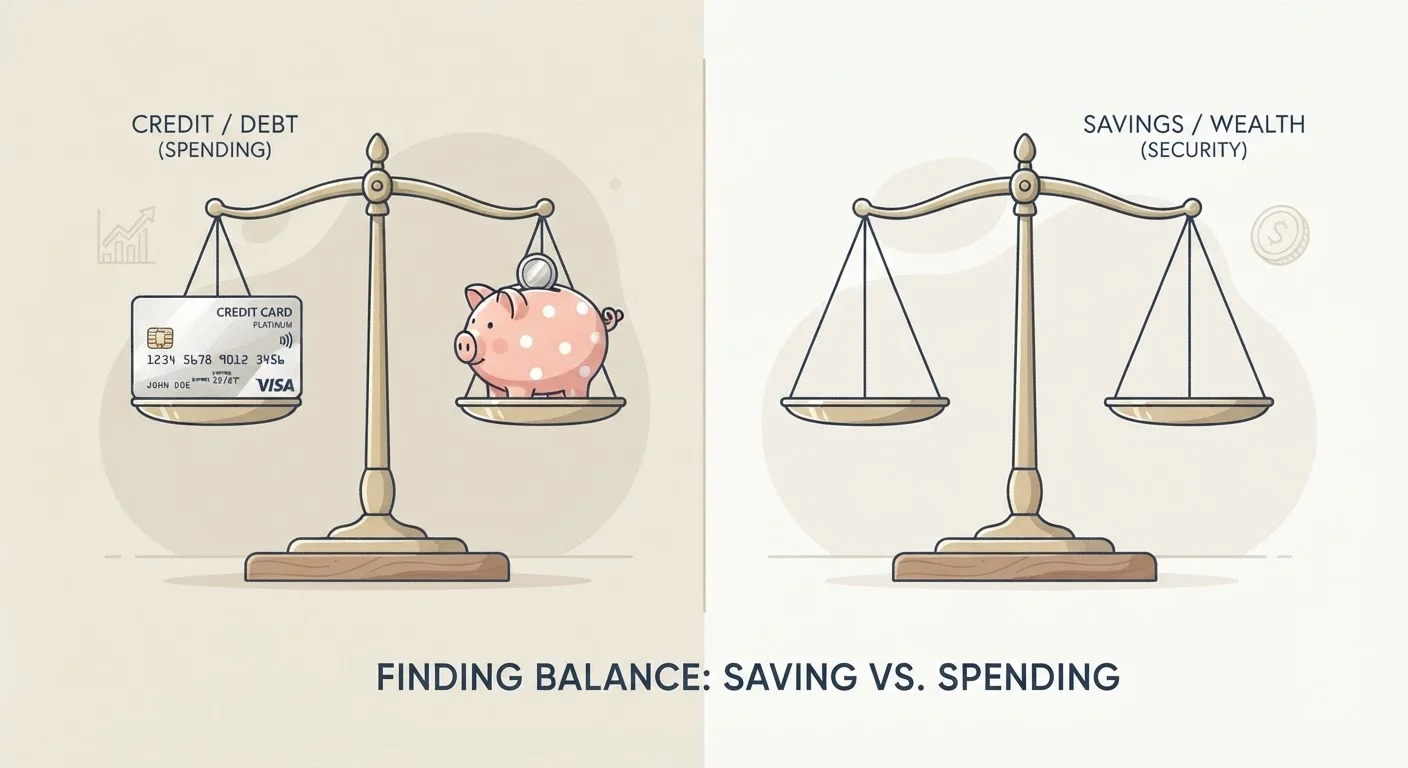
A question that comes up often: should you put every spare dollar toward your credit card balance, or set some aside as an emergency fund? The tension is real. High-interest debt is expensive, but going without any savings cushion means the next car repair or medical bill could land right back on a credit card — restarting the cycle.
A widely referenced approach is to establish a small emergency reserve — commonly suggested as a few hundred to one thousand dollars — before redirecting all extra income to debt. This is not about building a full six-month fund before tackling debt; it is about having a modest firewall so that ordinary surprises do not undermine your progress.
Once that small buffer exists, directing additional dollars above the minimum payment toward your highest-rate debt reduces the principal faster, which directly reduces the interest charged the following day. Even an extra $25 or $50 per month accelerates payoff and can save a meaningful amount in interest over the life of the balance.
For context on why the math often favors paying down high-rate debt before prioritizing savings growth, the article high-interest debt vs. low-yield savings walks through how interest rates on each side of the equation interact.
If your debt load has grown to the point where juggling multiple balances feels unmanageable, it may be worth understanding your options. Debt consolidation is one tool some people use — but it comes with trade-offs worth understanding before acting. And when you are ready to look for budget room to accelerate repayment, practical ways to find extra money in your budget offers realistic strategies that do not require a dramatic lifestyle overhaul.
This article is for general informational and educational purposes only and does not constitute personalized financial or legal advice. Please consult a qualified financial professional for guidance specific to your situation.