

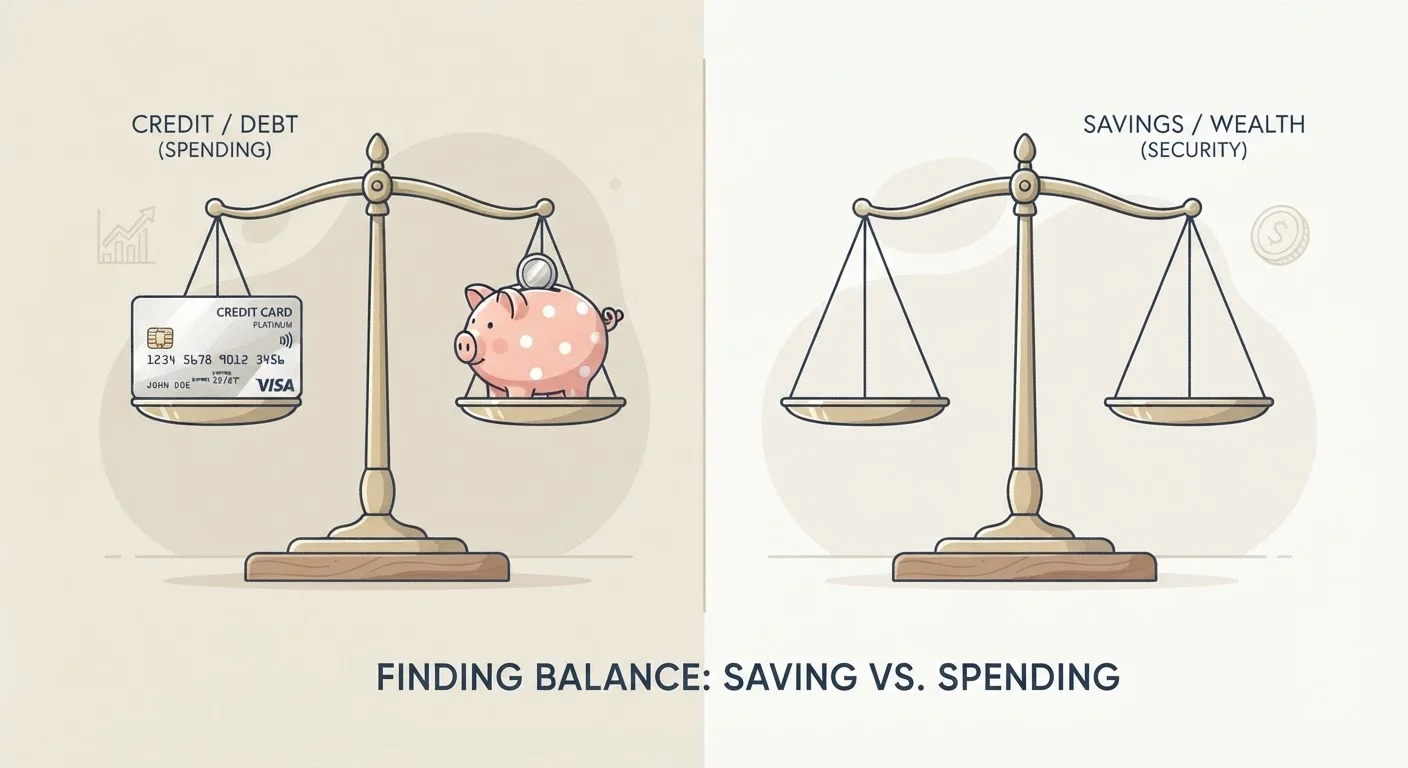
Why the Interest Rate Gap Is the Only Number That Matters
The core question in this trade-off is straightforward: which rate is higher — the interest you owe on your debt, or the interest you earn on your savings? If your credit card charges 22% APR (annual percentage rate) and your savings account earns 4.5% APY (annual percentage yield), you are losing roughly 17.5 cents on every dollar you keep in savings instead of paying down that balance.
That difference is not abstract. It compounds daily on most credit cards, meaning the gap between what you owe and what you earn widens a little every single day. For a plain definition of how compounding works in practice, see our glossary of key debt and savings terms.
This is why the standard personal finance guidance leans toward prioritizing high-interest debt repayment. It is not a philosophical preference — it is arithmetic. Paying off a debt charging 20% APR is equivalent to earning a 20% guaranteed return, which no federally insured savings product currently offers.
| Criterion | High-Interest Debt | Low-Yield Savings |
|---|---|---|
| Typical rate range | 15%–29% APR (credit cards) | 3%–5% APY (HYSA) |
| Effect on net worth | Reduces it daily via compounding interest | Grows it slowly via interest earned |
| Liquidity | None — paying it down is irreversible short-term | High — funds accessible quickly |
| Risk of doing nothing | Balance grows; costs escalate | Opportunity cost; negative real return vs. debt |
| Best mathematical use of $1 | Paying it down = guaranteed return equal to APR | Earning APY, which is lower than most debt rates |
| Protection against emergencies | None — no cash buffer created | Yes — reduces need to borrow again |
The Case for Keeping Some Savings Even While in Debt
The math favors debt repayment, but math alone does not run a household. Life produces car repairs, medical bills, and job disruptions on no particular schedule. Without any cash reserve, those events get paid for with more debt — often at the same high rate you were trying to eliminate.
Many financial educators suggest building a small starter emergency fund before accelerating debt payments. The logic is behavioral as much as financial: if every unexpected expense goes back on a credit card, the cycle of debt never actually breaks. To understand what happens when you only meet minimums during that cycle, see how minimum payments extend repayment timelines.
The amount commonly cited for a starter fund ranges from $500 to $1,000 — enough to absorb a moderate emergency without reaching for credit. Once that baseline exists, the stronger mathematical case for directing surplus dollars toward high-rate debt becomes easier to act on.
How to Run the Numbers for Your Own Situation
Pull two figures: the APR on your highest-interest debt and the APY on your savings account. Subtract the savings yield from the debt rate. That gap is your effective cost of holding savings instead of paying down debt. The larger that number, the more urgently debt repayment makes financial sense.
If your debt is at lower rates — federal student loans, for instance, which have historically been in the 3%–7% range — the gap shrinks. At that point, saving and paying debt simultaneously may be nearly equivalent on a pure return basis, and other priorities like employer-matched retirement contributions could shift the calculus further. For a practical look at dividing your paycheck between these goals, our guide on splitting income between saving and debt repayment walks through that process step by step.
Also worth checking: whether consolidating high-rate balances could lower your effective interest rate and change this math entirely. Debt consolidation has real trade-offs and is not always the right move, but understanding the option helps you see the full picture.
This article is for general informational and educational purposes only and does not constitute personalized financial, tax, or legal advice. Consult a qualified financial professional before making decisions based on your individual circumstances.