
What the Right PSI Actually Does
Tire pressure determines the shape and stiffness of the tire as it contacts the road. When inflated to the correct PSI, a tire maintains the right footprint — the amount of rubber making contact with the pavement at any moment. That footprint is what gives your car grip for steering, cornering, and braking.
Manufacturers calculate the recommended PSI based on the vehicle's weight, suspension design, and expected load. It's a balance: the tire needs to be firm enough to support the car efficiently but flexible enough to absorb road imperfections and maintain even tread contact.
That balance is thrown off the moment pressure drifts too far in either direction.
The Door Sticker, Not the Tire Sidewall
The PSI number molded into the sidewall of a tire is that tire's maximum rated pressure — not the recommended operating pressure for your vehicle. Using the sidewall number can lead to significant overinflation. Always use the placard on the inside of your driver's door or your owner's manual as the reference. Front and rear axles may have different specifications.
The Real Risks of Underinflation
Underinflation is by far the more common problem for most drivers. A tire that's even 8–10 PSI below spec can behave noticeably differently — and a tire that looks fine visually may already be dangerously low.
Here's what actually happens inside an underinflated tire: the sidewalls flex more than they should with every rotation. That excess flexing generates heat. Heat is one of the primary causes of tire failure, and sustained driving on an underinflated tire significantly raises the risk of a blowout, particularly at highway speeds.
Beyond the safety risk, underinflated tires wear unevenly — typically on both outer edges of the tread — shortening the tire's usable life. Fuel economy also suffers because a soft tire creates more rolling resistance, making the engine work harder to move the vehicle forward.
~1 PSI
Pressure lost per 10°F temperature drop
This is a widely cited rule of thumb from tire engineering and is reflected in guidance from the U.S. Tire Manufacturers Association.
0.2%
Fuel economy lost per 1 PSI underinflation
The U.S. Department of Energy estimates fuel economy improves by about 0.5–3% when tires are kept at proper inflation, depending on conditions.
25%
Tires that are significantly underinflated at any time
Studies by the National Highway Traffic Safety Administration (NHTSA) have consistently found a substantial share of vehicles on the road are operating with at least one underinflated tire.
Why Overinflation Is Also a Problem
It's tempting to think that more pressure equals better performance, but overinflation creates its own set of issues. A tire pumped too hard becomes rigid and reduces its contact patch — only the center of the tread bears the load instead of the full width.
That rigidity means the tire transmits more road shock into the suspension and cabin, making for a harsher ride. More importantly, reduced contact area means less traction. Overinflated tires can feel fine in normal highway driving but respond poorly in emergency maneuvers or wet conditions. Center-tread wear — a strip of worn rubber down the middle of the tire — is a telltale sign of chronic overinflation.
Temperature Changes and Seasonal Pressure Loss
Even a properly inflated tire loses pressure over time — tires are permeable and air slowly escapes through the rubber and around the valve stem. But the most dramatic pressure swings come from temperature changes.
As a general rule, tire pressure drops roughly 1 PSI for every 10°F drop in ambient temperature. That means a set of tires inflated correctly in September could be noticeably low by December without a single slow leak involved. This is why the tire pressure warning light (TPMS — Tire Pressure Monitoring System) on many vehicles tends to trigger in early morning during fall and winter.
Check pressure when tires are cold — before driving more than a mile or two — because driving heats the air inside and inflates readings temporarily. For a deeper look at how tire care fits into a broader maintenance routine, see our guide on tire rotation vs. wheel alignment.
How to Check and Maintain Correct Pressure
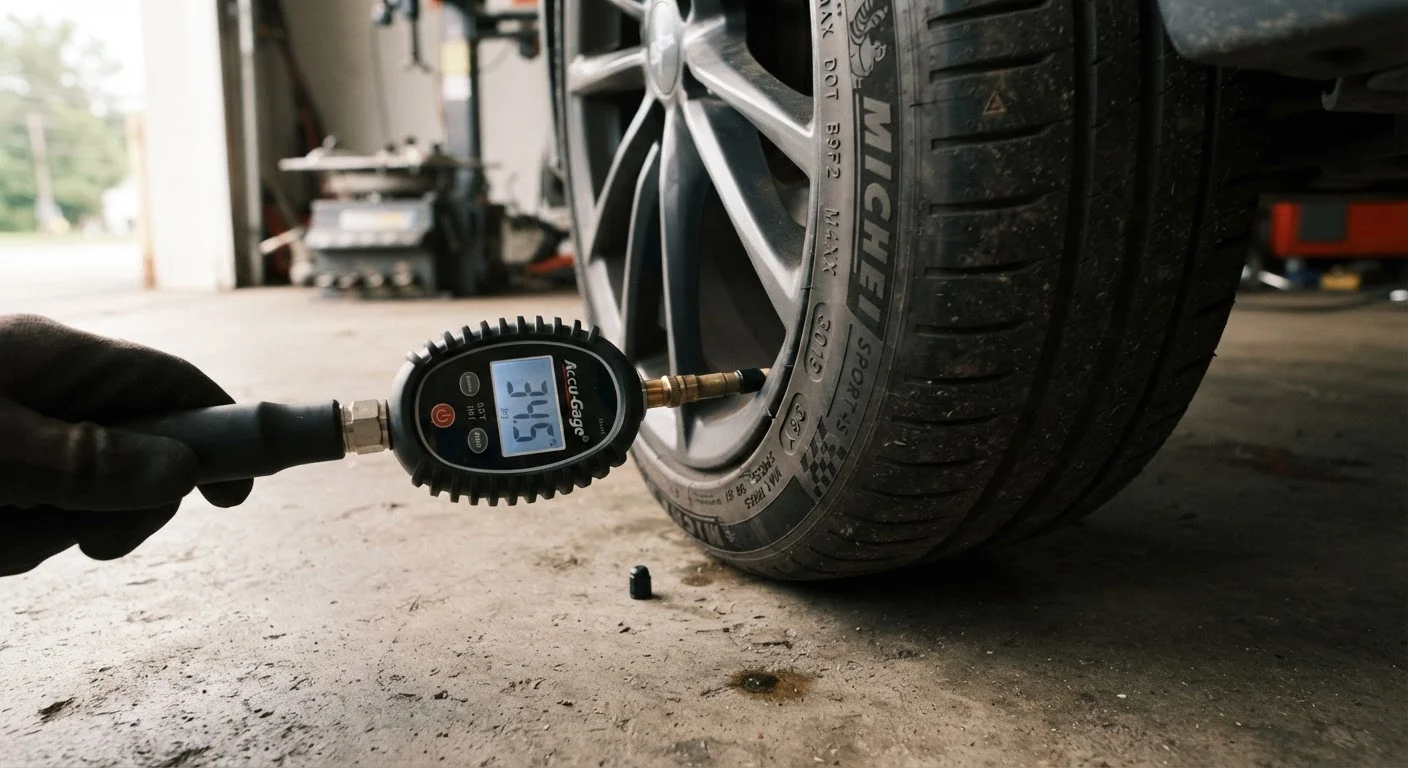
Checking tire pressure requires only an inexpensive tire pressure gauge — a simple tool most drivers should keep in the glovebox. Remove the valve cap from the tire, press the gauge firmly onto the valve stem, and read the result. Compare it against the sticker on your driver's door jamb.
If pressure is low, add air at a gas station air pump or home compressor in short bursts, checking frequently. If it's too high, use the small pin on the back of many gauges — or a pen tip — to depress the valve and release small amounts of air.
Building a monthly tire pressure check into your routine is one of the simplest, zero-cost maintenance habits available. It's also worth questioning some of the persistent myths around car maintenance — our article on common car maintenance myths covers several that cost drivers money unnecessarily.